Key Takeaways
- Bumps on the face do not always mean acne, clogged pores, or inflammation. Patients may also be describing enlarged pores, acne scars, roughness, or broader uneven skin texture.
- At Dr Valentin, we first work out what is creating the uneven surface before deciding whether it falls within what we can address.
- Concerns such as acne scarring, enlarged pores, and textural irregularities may be suitable for treatments such as Sylfirm X, Pico Laser, or selected collagen laser treatments after assessment.
- Not every raised lesion is a texture problem. Milia, sebaceous hyperplasia, active inflammatory lesions, skin growths, and changing or symptomatic bumps may need a different approach.
- The treatment decision depends on whether the concern comes from a lesion sitting on the skin, a change within the pore, or structural irregularity in the skin itself.
When You Say “Bumps”, We First Work Out What You Mean
Patients often come to us to address bumps on their face, but they are not always referring to pimples.
Some people are pointing to small raised spots. Others are describing skin that looks uneven under side lighting, feels rough when they run a hand across it, or has an irregular surface after years of acne. Enlarged pores can also create shadows and surface variation that patients simply describe as “bumpy skin”.
That difference changes the entire consultation.
At our medical aesthetic clinic, we do not start by deciding which machine to use. We first ask what is producing the unevenness. Is there an active lesion? Is the facial surface irregular because of scarring? Is the skin actually depressed in some areas, making the surrounding areas look more raised? Are enlarged pores contributing to the appearance? Or are we looking at a discrete skin growth that should not be treated as a texture concern?
The word “bumps” is therefore better thought of as a description of what the patient sees or feels, rather than a diagnosis in itself.
What We Can Address at Dr Valentin
Acne Scarring That Creates an Uneven or “Bumpy” Surface
One of the most important distinctions we make is between active acne and the texture left behind after acne has settled.
Acne scars do not all look like obvious pits. Depressed scars can create an irregular surface with alternating high and low points, while some acne scars can also be raised. Depressed ice-pick, rolling, and boxcar scars are different from raised scars such as hypertrophic and papular scars. Papular acne scars, in particular, can appear as small skin-coloured bumps and may be mistaken for acne.
So when someone points to what they describe as bumps on their face after previous acne, we look at whether the concern is really residual scarring or textural irregularity rather than a new breakout.
For selected acne scars and uneven texture, we may consider Sylfirm X treatment. Sylfirm X combines microneedling with radiofrequency energy to support collagen remodelling and is used at our clinic for concerns including acne scars, enlarged pores, and uneven texture.
Depending on the scar pattern, we may also discuss Pico Laser or a collagen-remodelling laser. The important distinction is that we are treating the structural texture concern we have identified, not simply treating anything that looks raised.
Enlarged Pores and Uneven Texture
Some patients do not have obvious scars or active acne. Their main concern is a coarse or uneven surface, especially across the cheeks, nose, or areas that become more noticeable under strong lighting.
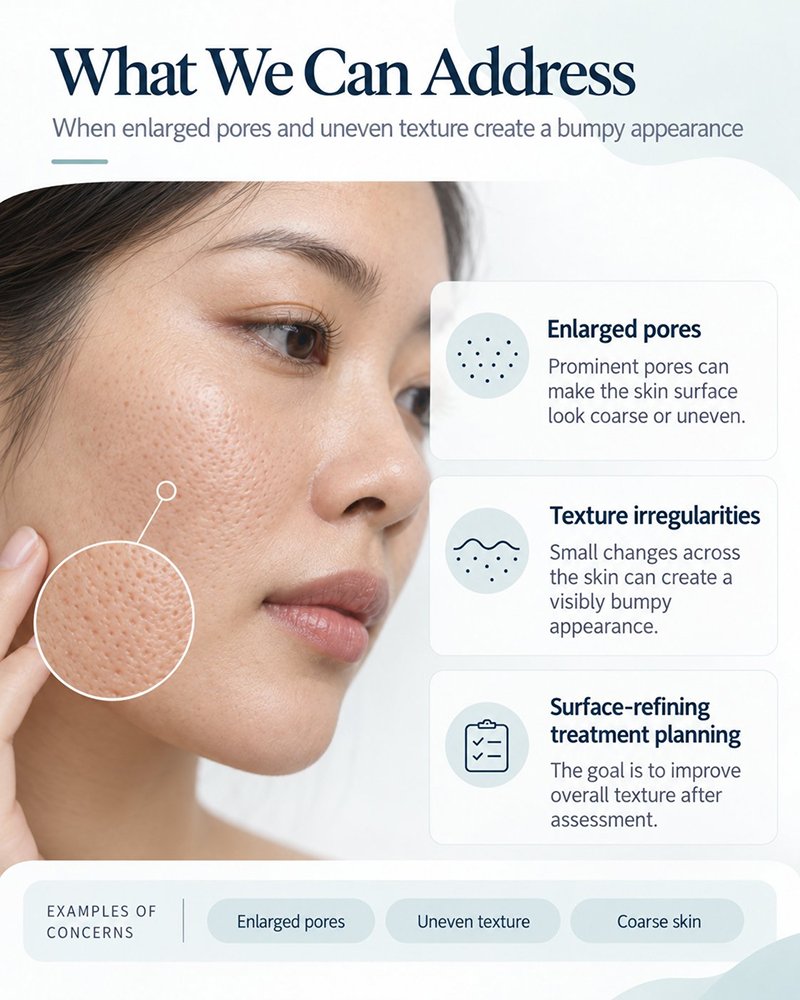
Enlarged pores can contribute to this. A pore is technically an opening rather than a bump, but when multiple pores are prominent, the combination of small depressions, shadows, and surrounding skin can make the complexion look uneven.
This is another situation where a patient’s “bumpy skin” may actually be a texture complaint rather than a collection of raised lesions.
Treatments such as Sylfirm X, Pico Laser, and selected collagen laser treatments may be considered for enlarged pores and uneven skin texture. Our choice depends on the degree of textural change, the presence of pigmentation, previous treatments, skin type, and how much downtime is acceptable.
We are not trying to “remove” each visible pore. We are looking at whether improving collagen support and overall skin texture may help the surface appear more refined.
Post-Acne Texture With Pigmentation
Sometimes bumps on the face look more obvious because the unevenness is partly structural and partly visual.
A patient may have shallow acne scars together with post-inflammatory pigmentation. Darker marks can draw attention to depressions and textural irregularities, particularly where colour and shadow overlap.
In these cases, treating pigmentation alone may not fully address what the patient is seeing, while focusing only on texture may leave the discolouration behind.
Pico Laser may be considered when pigmentation and acne-related textural concerns coexist, while Sylfirm X or collagen laser treatments may be discussed where collagen remodelling and texture are stronger priorities.
This is where our assessment matters. We do not treat a photograph or a keyword. We look at the combination of colour, depth, pore appearance, scar pattern, and skin quality before deciding what is realistically addressable.
What We Would Not Address as a Simple Texture Problem
Milia and Other Discrete White Bumps
Small white bumps are often assumed to be clogged pores, but they may be milia.
Milia are small cysts containing keratin beneath the skin surface and are not a form of acne. They commonly occur on the face and are frequently mistaken for whiteheads.
If the bumps on your face are isolated, firm, and white, our first priority is identifying what they are. We would not recommend Sylfirm X, Pico Laser, or a collagen laser simply because they make the skin look uneven.
The same principle applies to other discrete raised lesions. A texture-focused treatment is intended to address broader skin quality or structural remodelling. It is not automatically the correct approach for an individual cyst, growth, or gland-related bump.
Sebaceous Hyperplasia and Other Skin-Coloured Growths
Sebaceous hyperplasia can appear as small flesh-coloured or yellowish bumps caused by enlarged sebaceous glands. These can resemble acne or clogged pores, even though the underlying structure is different.
When we see an isolated raised lesion, we assess the lesion itself before thinking about general resurfacing.
This is particularly important when patients have tried increasingly strong exfoliants because they assume every small bump comes from congestion. If the structure is not a clogged follicle, exfoliating more aggressively may not solve the concern.
Active, Inflamed, or Infected Lesions
If the bumps on your face are red, painful, swollen, crusted, or actively inflamed, we do not treat them as a straightforward texture issue.
Active acne may need to be brought under control before we focus on residual scarring or pores. Procedures may also need to be postponed where there is an active infection, open wound, or significant irritation. Patients with active infections or open wounds may need to delay treatment.
Our aim is to treat the right stage of the problem. Addressing old acne texture without considering ongoing inflammatory lesions can leave the underlying problem unresolved.
Changing, Bleeding, or Unusual Lesions
Some facial bumps fall outside what should be approached as an aesthetic texture concern altogether.
If a lesion is changing in size, shape, or colour, repeatedly bleeding, crusting, ulcerating, painful, or otherwise unusual, medical assessment takes priority over cosmetic resurfacing.
At our aesthetic clinic in Orchard, part of responsible treatment planning is recognising when an aesthetic device should not be the first step.
How We Decide Whether the Problem Is Really Texture
When we assess a patient at our aesthetic centre, we look beyond whether the skin feels smooth.
We consider:
- whether the irregularity is raised, depressed, or a mixture of both
- whether it follows the pattern of previous acne
- whether enlarged pores are contributing to the appearance
- whether pigmentation is making the texture appear more pronounced
- whether there are active inflammatory lesions
- whether one individual bump looks different from the surrounding skin
- how the texture changes under different lighting and facial angles
- previous acne, procedures, skincare, and healing response
These details help us decide whether the bumps on your face are something we can address through collagen remodelling, laser treatment, or another aesthetic approach, or whether the patient needs a different form of management.
Where Sylfirm X and Laser Treatments Fit
Once we establish that the bumps are actually related to facial acne scarring, enlarged pores, or uneven skin texture, device-based treatment becomes much more relevant.
Sylfirm X uses radiofrequency microneedling and may be considered for acne scars, enlarged pores, and textural irregularities. Pico Laser may be considered for acne scarring, pore appearance, pigmentation, and uneven texture. Dr Valentin also offers collagen laser treatments, including fractional resurfacing options, for concerns such as acne scars, enlarged pores, roughness, and uneven skin texture.
These treatments overlap, but they are not interchangeable. The appropriate option depends on the main concern, depth and pattern of scarring, skin type, pigmentation, downtime preferences, and previous treatment response.
We may also decide that a particular bump is not something these treatments are intended to address.
The treatment conversation therefore starts only after we understand what “bumpy” means for that particular patient.
Our Approach to “Bumpy” Skin
When patients come to us wanting to address the bumps on their face, we begin assessment for acne, and we do not generalise every visible irregularity.
Sometimes the concern is an active lesion. Sometimes it is a discrete bump that does not fall within the role of a texture-focused aesthetic treatment. In many other cases, however, the patient is describing enlarged pores, old acne scarring, or an uneven surface that may potentially be addressed through collagen remodelling or laser-based treatment.
At Dr Valentin, we first determine what is creating the uneven appearance, then discuss whether it falls within what we can reasonably address and which treatment approach fits the skin in front of us.
If you are unsure what is causing the bumps on your face, contact us to arrange a consultation and discuss whether treatment is appropriate.
Frequently Asked Questions
Can acne scars make my face look bumpy even if I no longer have acne?
Yes. Depressed acne scars can create uneven highs and lows across the skin, while some acne scars can also be raised. A bumpy appearance may therefore come from residual scarring rather than active acne.
Can enlarged pores make my skin look bumpy?
Yes. Enlarged pores create small depressions and shadows across the skin surface. When many are visible together, the complexion can appear coarse or uneven even though there are no true raised lesions.
Will Sylfirm X treat every type of bump?
No. Sylfirm X is used at Dr Valentin for concerns including acne scars, enlarged pores, and uneven texture. It is not a universal treatment for milia, skin growths, infected lesions, or every type of raised scar. Suitability depends on what we identify during assessment.
What if I cannot tell whether the bumps are acne, scars, or something else?
That is common. Rather than choosing a treatment based on appearance alone, we look at the structure, distribution, inflammation, colour, and history of the concern. This helps us determine whether the concern falls within the textural problems we treat or needs another approach.
When should I have bumps on the face assessed?
Consider an assessment if the unevenness persists, bothers you cosmetically, or you are unsure whether you are looking at acne, scars, enlarged pores, or another type of lesion. Changing, bleeding, crusting, painful, or unusual lesions should be medically assessed rather than assumed to be cosmetic.
 Dr Valentin Aesthetic And Laser Clinic Sg