
Key Takeaways
- Treatment stacking means planning two or more aesthetic treatments, each with a defined role. They are performed either in one visit or spread across separate appointments.
- A multi-modality treatment plan can make sense when concerns arise from different tissue layers or require different treatment mechanisms.
- We do not add procedures just to make a plan look more comprehensive. A second treatment should address something the first one does not adequately cover.
- Same-day treatment is not automatically more efficient. Aesthetic treatment sequencing can affect swelling, recovery, assessment, and how we plan the next step.
- At our aesthetic clinic in Singapore, we prefer a shorter plan with a clear rationale over a long list of procedures that partially overlap.
- Sometimes we recommend starting with one procedure, reviewing the response, and only then deciding whether another treatment is warranted.
Introduction
Treatment stacking is a term we hear increasingly often in consultations. Clients may arrive with several procedures already in mind and ask whether they can all be done together, whether combining them will produce a stronger result, or whether one treatment can “boost” another.
We understand why the idea is appealing. A face can show changes in pigmentation, texture, firmness, volume, and contour at the same time. Lasers, ultrasound devices, radiofrequency technologies, injectables, and threads also don’t all work the same way.
At Dr Valentin, we see treatment stacking as a planning question. We first identify the concern, decide which tissue or process appears to be contributing to it, and work out what each proposed treatment is expected to do. Only after that do we consider whether two procedures belong in the same plan at all.
When you consult an aesthetic doctor, the useful question is not “How many treatments can I combine?” It is “What does each treatment add?”
Why the Idea Appeals to Clients in Singapore
We can also understand why combining treatments has practical appeal in Singapore.
Many of our clients are balancing work, family commitments, travel, social events, and relatively full weekly schedules. If two suitable procedures can be planned around the same period, reducing separate clinic visits can be attractive.
Downtime is another consideration. Someone with an important meeting, wedding, holiday, or work trip coming up may prefer to organise treatment and recovery within a defined window, rather than repeatedly fitting individual procedures around several weeks of commitments.
We do not think that practical convenience should dictate the medical plan, though. A shorter calendar is only useful if the treatments themselves are suitable to combine. If separating procedures gives the skin more time to recover, allows us to assess the first response more accurately, or reduces unnecessary treatment burden, we would still recommend staging them.
How We Build a Treatment Plan
For us, treatment stacking does not have to mean several procedures completed on the same day.
A planned combination may involve treatments working at very different levels. For example, ultrasound-based treatments such as HIFU or Ultherapy can deliver energy into deeper tissue planes to stimulate collagen remodelling, while radiofrequency treatments primarily heat collagen-containing tissue within the dermis. Certain lasers are used more superficially for concerns such as pigmentation or skin texture, while injectables may be placed at selected depths depending on whether the aim is hydration, collagen stimulation, or volume support.
If several proposed procedures are targeting substantially the same concern, we may recommend starting with one and reviewing the response before adding another.
That is why we start with anatomy and the visible concern before discussing devices or products.
A client may tell us that the lower face looks less defined. Another may describe the skin as rough, dull, or uneven. Someone else may be concerned about both. Those descriptions can point us towards different targets, even when the concerns occur in the same face.
A layered treatment approach can be useful when those targets are genuinely separate. It is much less useful when several proposed treatments are all trying to solve essentially the same problem.
We Ask What Each Treatment Is Actually Doing
A common mistake is to build a plan from treatment names.
We prefer to work backwards from the concern.
- Ultrasound-based treatments: deliver focused energy at selected tissue depths to create controlled thermal stimulation and support collagen remodelling. Their role generally differs from superficial pigment or resurfacing treatments.
- Radiofrequency: uses electrical energy to generate heat within targeted tissue, commonly with the aim of collagen contraction and remodelling. Depth and delivery patterns depend on the device.
- Lasers: vary considerably. Some target pigment or vascular chromophores, while fractional lasers create controlled columns of injury for resurfacing and textural concerns.
- Injectables: work very differently again. Depending on the product and placement, they may be used for hydration, collagen stimulation, contour support, or volume replacement.
- Threads: involve physical placement beneath the skin and may provide mechanical support or repositioning in selected cases.
If someone is researching a HIFU non-surgical facelift, for example, we first assess whether the concern is actually one that an ultrasound-based treatment may be suited to address. If the same client also wants treatment for pigmentation or uneven surface texture, that becomes a separate assessment.
Likewise, someone asking about a thread facelift in Singapore may also have questions about energy-based treatments. We would not assume that both are needed just because both can appear in discussions about facial lifting or contouring. We look at the degree and location of laxity, skin quality, facial structure, previous procedures, and the role each proposed treatment would play.
This is where a stacked treatment plan should become more precise, not more crowded.
If two procedures overlap, we may decide one is enough. If they target clearly different concerns, there may be a reason to include both. If the second procedure adds little at that stage, we would prefer to leave it out.
We Think About Depth, Mechanism, and Timing
Where a treatment acts also affects how we plan the sequence. An ultrasound treatment may create controlled thermal stimulation at deeper tissue levels, while a laser may act closer to the skin surface and temporarily increase redness or sensitivity. An injectable introduces product directly into tissue, and threads involve mechanical placement beneath the skin.
If these treatments are planned close together, we need to consider whether heat, swelling, inflammation, or tissue manipulation from one procedure could affect the accuracy, comfort, or recovery of the next.
Combined aesthetic procedures require individual assessment, treatment sequencing, and follow-up when several modalities are used. The guidance also notes that where microfocused ultrasound with visualisation and injectable agents are performed on the same day, the ultrasound procedure is generally performed first. Read the Pan-Asian consensus article
We do not treat that as a universal rule for every device-and-injectable pairing. It is a useful example of why combination treatment needs procedure-specific planning.
Before combining treatments, we may ask:
- At what depth does each procedure act?
- Will the first treatment cause swelling, heat, inflammation, or tenderness that could affect the second?
- Will the second procedure make it harder to judge the response to the first?
- Would spacing the treatments give us better information?
- Does the added procedure address a separate concern strongly enough to justify the extra treatment burden?
These questions often tell us more than a pre-set package ever could.
Same-Day Treatment Is Not Always the Goal
A common misconception is that a stack is only worthwhile if everything happens in one appointment.
We do not see it that way.
In some cases, we may consider same-day treatment after assessment. There are also many situations where a staged aesthetic plan gives us more control.
When treatments are performed in the same visit, the sequence can affect how accurately we can perform the second procedure. An energy-based treatment may cause temporary redness, warmth, or swelling. An injectable may immediately alter tissue contours. Thread placement creates mechanical manipulation beneath the skin. These effects can affect how easily we assess landmarks, judge symmetry, or treat the next area precisely.
Spacing treatments allows us to see what the first procedure has achieved before deciding what still needs attention. That can be particularly relevant when a treatment works gradually. If we add another modality too early, we may be treating a concern that would have changed with time anyway.
Staging can also make recovery easier to interpret. If redness, swelling, tenderness, or sensitivity occurs after several procedures in the same sitting, it can be harder to know which treatment contributed most.
In some combinations, we complete the first treatment and reassess the skin before proceeding. In others, we may deliberately separate sessions so that swelling settles and the tissue response becomes clearer.
For us, the plan can therefore involve one appointment, several appointments, or stopping after the first step because the next one is no longer necessary.
More Procedures Can Also Mean More Treatment Burden
A multi-treatment strategy has to account for recovery, not only potential benefit.
Every procedure has its own expected tissue response. Depending on the treatment, that may include temporary redness, swelling, sensitivity, bruising, or other after-effects.
Combining procedures can increase the total inflammatory load within the same treatment window. One treatment may cause heat and erythema, another may add swelling or bruising, and a resurfacing procedure may temporarily weaken the skin barrier. Even when each treatment is individually well tolerated, performing them close together can change how long redness, tenderness, swelling, or sensitivity lasts.
We also consider whether aftercare instructions conflict. A treatment that requires keeping the skin cool and minimally manipulated may not pair well with another procedure that involves injections or additional handling of the same area.
That is why we assess your skin’s condition before adding another treatment. Active irritation, inflammation, barrier disruption, recent procedures, a history of difficult reactions, or significant upcoming commitments can all influence timing.
Research also does not support treating all aesthetic combinations as interchangeable.
That is one reason we do not take findings from one combined treatment approach and apply them automatically to every laser, injectable, ultrasound device, radiofrequency treatment, or thread procedure.
What We Want Clients to Ask During a Consultation
If you are considering several aesthetic procedures, bring the list with you. It gives us a useful starting point.
We would also encourage you to ask more specific questions:
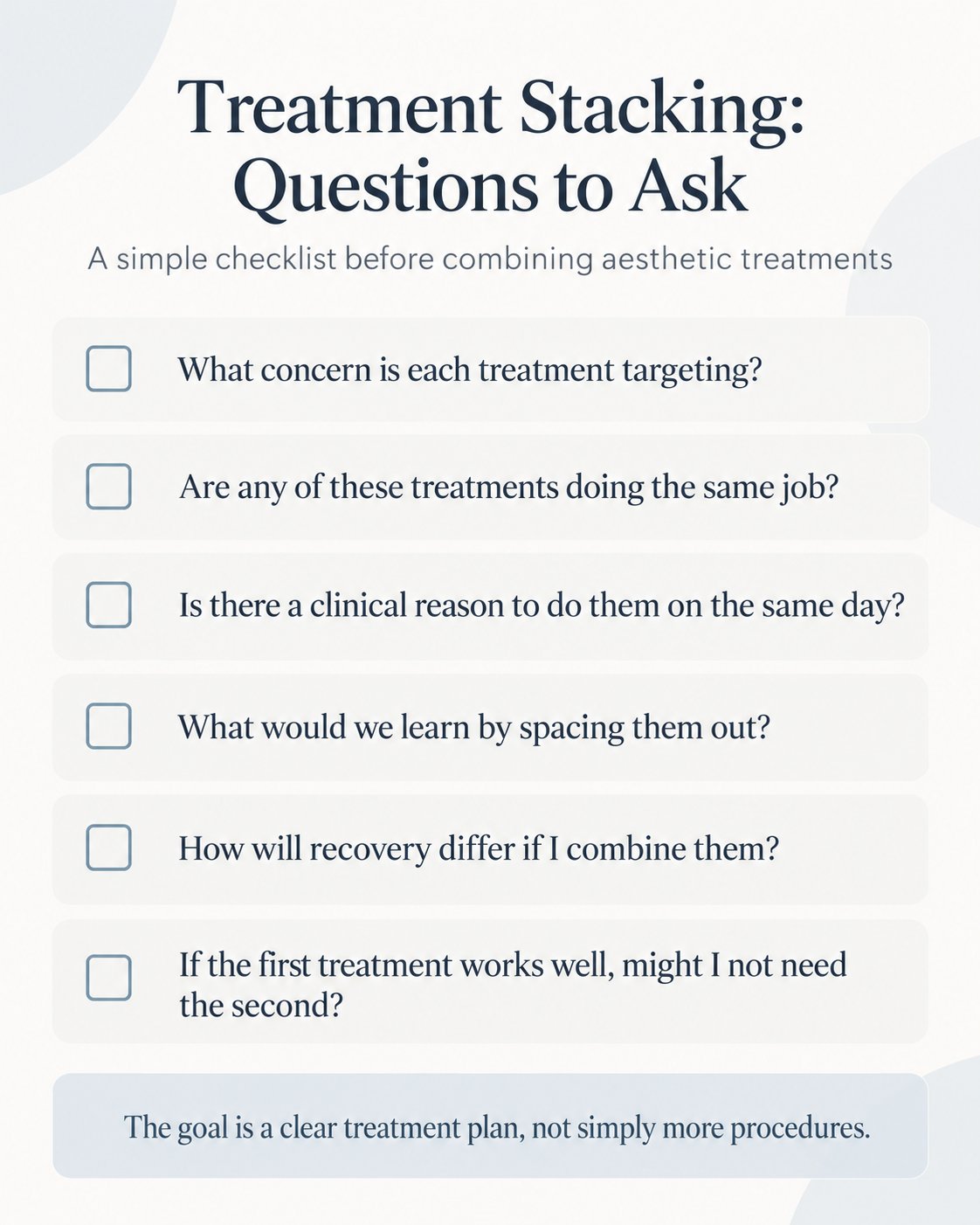
- What concern is each treatment targeting?
- Are two of these treatments doing essentially the same job?
- Is there a clinical reason to do them on the same day?
- What would we learn by spacing them out?
- How will the combined recovery compare with having them separately?
- If the first treatment works well, might we decide not to proceed with the second?
Those questions make treatment stacking a conversation about planning, not quantity.
They also help us build a multi-modality aesthetic treatment around what we actually see during assessment, instead of working from a fixed combination that may not fit every face or skin condition.
How We Plan Combination Treatments at Dr Valentin Low
Our approach starts with a simple rule: every treatment needs a job.
We assess the concern, facial anatomy, skin condition, previous procedures, treatment goals, and recovery tolerance. If several modalities seem useful, we decide whether to use them together, separate them by an interval, or introduce them one at a time.
Sometimes that leads to a plan involving different targets. Sometimes we recommend one treatment first and review before adding anything else.
The number of procedures is never the point. The plan should make sense when you consider each component on its own and when you view the treatments together.
If you are considering several aesthetic procedures and are unsure which ones belong in the same plan, contact us for an assessment. We can discuss your concerns, previous treatments, and options before deciding whether a single treatment or a carefully planned combination may be suitable.
Frequently Asked Questions
Can you do two treatments on the same area in one appointment?
Sometimes, but it depends on how each treatment works, the tissue depth involved, and the expected response to the first procedure. If one treatment causes significant heat, swelling, redness, or tissue manipulation, we may prefer to complete the second treatment at another appointment. We also consider whether treating the same area twice in one session would add meaningful benefit or simply increase recovery.
Can I have several aesthetic treatments on the same day?
Possibly. We consider the treatment mechanisms, areas involved, expected swelling or inflammation, skin condition, and sequence. Some procedures may be compatible in one appointment, while others may be better separated.
Can energy-based treatments and injectables be combined?
They can sometimes form part of the same combined aesthetic treatment plan, but timing depends on the specific device, injectable, treatment depth, anatomical area, and individual circumstances. No single sequence applies to every combination.
How long should I wait between treatments?
There is no universal waiting period. The interval depends on what was performed, how the skin responds, the expected treatment timeline, and what we need to assess before the next procedure.
Is treatment stacking suitable for sensitive skin?
It depends on the cause and current condition of the skin. If there is active irritation, inflammation, or barrier disruption, we may postpone part of the plan or simplify it until the skin is in a more suitable condition for treatment.
Does the order of treatments matter when procedures are combined?
Yes, in some combinations. An energy-based treatment may be performed before an injectable if swelling or tissue changes from the injection could affect treatment accuracy. Other combinations may require different sequencing. The order depends on the technologies used, treatment area, depth, and expected tissue response, so no single sequence applies to every treatment stack.
 Dr Valentin Aesthetic And Laser Clinic Sg