
One question we regularly hear from clients is whether a medical aesthetic clinic is really different from a beauty salon when both may appear to address concerns such as pigmentation, skin texture, facial ageing, or general skin quality.
There are various factors, but one of the answers is: aesthetic guidelines.
In Singapore, medical aesthetic practice sits within a healthcare framework. Aesthetics guidelines set professional expectations around which procedures doctors may perform, the competency required for certain procedures, and responsible medical practice. Healthcare licensing and professional registration add further layers of accountability.
Compliance shapes what happens before, during, and after treatment. A medical consultation assesses suitability, relevant risks, limitations, and treatment planning, while a beauty salon generally focuses on non-medical beauty, skincare, and wellness services. For clients deciding where to seek care, we think this framework matters more than simply comparing treatment names.
Key Takeaways
- Aesthetics guidelines help define how doctors in Singapore should approach aesthetic procedures, including approved procedures and competency requirements.
- Aesthetics guidelines work alongside healthcare licensing, medical registration, and professional standards rather than functioning as a standalone rulebook.
- A medical aesthetic clinic is structured around clinical assessment, suitability, risk discussion, treatment planning, and follow-up where appropriate.
- Beauty salons generally focus on non-medical cosmetic, skincare, and wellness services, so the service journey is different even when the concerns discussed sound similar.
- When choosing an aesthetic clinic, we recommend looking beyond the treatment name and asking who will assess you, who will perform the procedure, and what safeguards apply.
What Are Aesthetics Guidelines in Singapore?
When clients ask us about aesthetics guidelines, they are usually asking a broader question: “What rules are medical aesthetic clinics expected to follow?”
In Singapore, the answer has several layers. The Singapore Medical Council (SMC) publishes professional guidance for doctors performing aesthetic procedures. Medical practitioners must also meet registration requirements, while providers of regulated healthcare services need the relevant licences.
The SMC Guidelines on Aesthetic Practices for Doctors
The most direct reference point is the Singapore Medical Council’s Guidelines on Aesthetic Practices for Doctors. Doctors carrying out, or intending to carry out, aesthetic procedures should refer to its approved procedures.
These aesthetics guidelines divide approved procedures into two tables. Table 1 covers procedures that non-specialists and specialists outside the Table 2 groups may perform if they meet the stipulated requirements. Where the historical requisite number of procedures was not met, the SMC states that a Certificate of Competence, or COC, is required.
Table 2 covers approved procedures for specified specialists, including dermatologists, plastic surgeons, and certain other specialists with relevant training.
For clients, the practical point is that medical aesthetic procedures are not an unrestricted menu that any doctor may automatically offer.
Competency Is Part of the Framework
We find that clients sometimes assume that being a doctor automatically means being able to perform every aesthetic procedure. The aesthetics guidelines show why that is too simplistic.
Depending on the procedure and the doctor’s circumstances, competency requirements may apply. The SMC also states that completing a COC course does not remove a doctor’s professional responsibility if a complaint or disciplinary inquiry arises.
This matters for aesthetic treatment safety because competency sits alongside professional accountability. When speaking with an aesthetic doctor, clients can ask what the treatment does, why it may suit them, and what training or experience is relevant.
Medical Practice Also Requires Registration and Licensing
The aesthetics guidelines are one part of a wider regulatory structure.
All medical practitioners in Singapore must be registered with the SMC and hold a valid Practising Certificate before practising medicine. At the service level, the Ministry of Health (MOH) states that providers offering regulated healthcare services under the Healthcare Services Act (HCSA) must hold the relevant licence. Outpatient Medical Service is one of the services regulated under the Act.
MOH states that clinical aesthetic procedures performed by registered medical and dental practitioners are regulated under the HCSA, with penalties for unauthorised providers. Its explanation of the regulation of unlicensed aesthetic treatments is useful reading for consumers who want to understand why provider credentials matter.
The distinction matters: regulation applies not only to the procedure, but also to the practitioner and healthcare service delivering care.
Why Do These Standards Exist?
The purpose of aesthetics guidelines is to provide boundaries for responsible practice. For clients, that brings clinical questions to the foreground: Is the procedure appropriate? Are there contraindications? What are its limitations and risks? What happens if the response is unexpected? These considerations explain why the regulatory framework matters.
How Compliance Shapes Medical Aesthetic Care
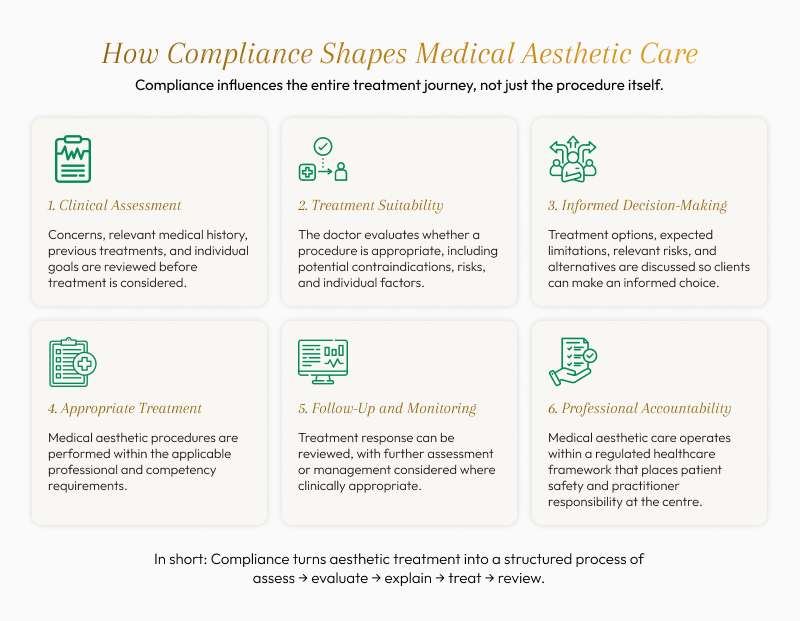
Knowing that aesthetics guidelines exist is only the first half of the story. For clients, compliance becomes visible in how consultations are conducted, suitability is assessed, and care is followed up.
Assessment Comes Before the Procedure
A client may arrive asking about a device, injectable, or treatment seen online. Our role is not simply to confirm the request. The aesthetic consultation process should first establish the concern and whether the proposed approach is appropriate. That may involve examining the skin or facial structure, reviewing relevant history and previous procedures, and clarifying expectations.
The regulatory framework sits behind this more clinical way of thinking. The treatment is considered in relation to the person receiving it, rather than being treated as an isolated service.
This is also why two clients asking about the same concern may receive different recommendations.
Suitability Includes Knowing When Not to Treat
An important part of medical aesthetic care is knowing when not to proceed. Availability does not make a procedure appropriate for everyone. Medical conditions, medications, skin status, previous treatments, anatomy, or expectations may affect suitability.
Compliance with these standards therefore supports a decision-making process in which the question is not simply “Can this treatment be done?” but “Should it be done for this client, at this time?”
For us, that distinction is central to responsible aesthetic practice.
Risks, Limitations, and Follow-Up Form Part of Care
Clients understandably focus on what a treatment might achieve, but a medical discussion also covers limitations. Depending on the procedure, risks, recovery, alternatives, and aftercare may be relevant. The aesthetics guidelines operate within broader professional duties that keep these considerations part of medical decision-making.
Follow-up also matters. Some procedures may require review, while unexpected symptoms or treatment responses may require medical assessment. This ability to evaluate and manage the client’s progress is part of what gives a medical aesthetic clinic its clinical character.
How Does This Differ From a Beauty Salon?
This is where the comparison becomes clearest. Compliance with aesthetics guidelines influences the scope of services, practitioner responsibilities, and the pathway a client follows. Beauty salons have a legitimate role in beauty and skincare, but their typical services are non-medical rather than outpatient medical care.
Are the Treatments Available the Same?
Not necessarily.
A beauty salon may provide facials, cleansing, exfoliation, massage, and other non-medical cosmetic or wellness services. A medical aesthetic clinic may assess and provide medical aesthetic procedures, including certain injectable or energy-based options, where appropriate and within the applicable professional framework.
The aesthetics guidelines matter when a procedure falls within medical aesthetic practice because they help define approved procedures and competency expectations for doctors.
We therefore encourage clients not to judge providers solely because they address the same concern. “Pigmentation”, “ageing”, or “skin tightening” does not necessarily mean the same treatment or level of clinical involvement.
How Does the Workflow Compare?
The difference becomes even clearer when we look at the typical journey.
| Medical aesthetic clinic | Beauty salon |
|---|---|
| Discuss concerns and medical or aesthetic history where relevant | Discuss beauty or skincare concerns |
| Conduct a clinical assessment | Assess cosmetic preferences or skincare needs |
| Determine suitability for a medical procedure | Recommend an appropriate non-medical service |
| Discuss treatment options, limitations, and relevant risks | Explain the selected beauty service |
| Develop an individualised treatment approach | Deliver the chosen cosmetic or wellness service |
| Perform treatment where appropriate | Provide the service |
| Arrange medical follow-up or reassessment where required | Suggest maintenance appointments or home-care products |
Workflows vary, but the distinction goes beyond who owns a machine or what a treatment is called. In a regulated medical setting, aesthetics guidelines and wider healthcare obligations place clinical judgement at the centre of the journey.
What Should You Look for When Choosing a Provider?
When clients ask us about choosing an aesthetic clinic, we recommend starting with the nature of the service rather than its popularity on social media.
Useful questions include:
- Is this a medical procedure or a non-medical beauty service?
- Who will assess me before treatment?
- Who will perform the procedure?
- What qualifications or competency requirements apply?
- What risks, limitations, and alternatives should I understand?
- What follow-up is available if I have concerns afterwards?
Understanding the regulatory framework gives these questions context. It helps consumers recognise why medical aesthetic care involves more than selecting a treatment from a list.
If you are considering aesthetic treatments, we believe the consultation should explain both what may be considered and why it fits your circumstances.
Medical Aesthetic Care at Dr Valentin
From the questions we receive, we know that many clients are not simply looking for another procedure. They want to understand whether a treatment is appropriate, what trade-offs are involved, and how it fits into their longer-term goals.
At Dr Valentin, we approach aesthetics guidelines as part of the wider responsibility that comes with providing medical aesthetic care. We begin by understanding your concerns, assessing relevant factors, and discussing options that may be suitable rather than applying the same treatment pathway to everyone.
Our focus is on helping clients make informed decisions with realistic expectations, appropriate medical oversight, and a treatment plan that reflects their individual needs.
If you are considering medical aesthetic care and would like to discuss your concerns with us, contact us to arrange a consultation.
Frequently Asked Questions
What are aesthetics guidelines in Singapore?
The term aesthetics guidelines commonly refers here to the SMC’s Guidelines on Aesthetic Practices for Doctors, which set out approved procedures and relevant requirements. They sit within a wider framework of medical registration, professional duties, and healthcare licensing.
Can any doctor perform every aesthetic procedure?
No. The SMC framework distinguishes categories of approved procedures and sets competency requirements in relevant circumstances. Medical registration alone does not mean a doctor is automatically competent to perform every aesthetic procedure.
Are beauty salons allowed to offer aesthetic services?
Beauty salons may provide non-medical beauty, cosmetic, and wellness services. The important question is whether a particular service amounts to a clinical aesthetic procedure or regulated healthcare service. MOH states that clinical aesthetic procedures performed by registered medical and dental practitioners are regulated under the HCSA.
How do aesthetics guidelines affect aesthetic treatment safety?
Aesthetics guidelines contribute to aesthetic treatment safety by setting professional boundaries around approved procedures and competency. They work alongside registration, licensing, ethical obligations, clinical judgement, and other healthcare requirements. No guideline can remove all treatment risk, which is why individual assessment and appropriate follow-up remain important.
How can I check whether I am visiting a medical clinic?
Consumers can check provider credentials and whether the doctor is registered to practise in Singapore. MOH and SMC provide public resources for healthcare licensing and doctor registration. You can also ask who will assess and perform your procedure.
 Dr Valentin Aesthetic And Laser Clinic Sg